
Table of Contents
- Why Inclusive Bridal Sizing Matters More Than Ever
- Bridal Size Chart vs Street Size: What the Numbers Really Mean
- How to Measure for a Wedding Dress at Home
- Questions to Ask Bridal Salons About Sizing Before You Book
- Sample Gowns, Made-to-Order, and Custom Measurements Explained
- Budget-Conscious Inclusive Shopping and Emotional Boundary Setting
- Frequently Asked Questions
Last Updated: September 27, 2026
Why Inclusive Bridal Sizing Matters More Than Ever
Being handed a dress three sizes larger than what you wear every day is jarring, and for many brides that moment sparks panic instead of joy. Learning how to find inclusive bridal sizing starts with one fact: bridal sizing is not street sizing.
Bridal Size Chart vs Street Size: What the Numbers Really Mean
A bridal size chart is a set of body measurements that maps to dress sizes, and it rarely matches the street size you buy at a regular store. A woman who wears a size 8 in everyday clothing might measure into a bridal size 12.
Why Bridal Sizing Runs Smaller
Bridal sizing traces back to vintage pattern standards never updated for modern bodies, and many designers still cut gowns from those older blocks. Add structure, boning, and corset backs, and the numbers drift even further from a mall rack.
How to Read a Bridal Size Chart Without Panicking
- Find the brand's own chart. Every designer publishes a measurement chart, and they differ.
- Match your largest measurement to the chart, not your smallest.
- Ignore the number on the tag and focus only on the inches.
- Note that a corset back or adjustable elements can add or remove inches.
How to Measure for a Wedding Dress at Home
You can measure for a wedding dress at home in about 15 minutes with a soft measuring tape and a helper. Wear a fitted top or smooth bra, stand straight, and keep the tape snug but not tight.
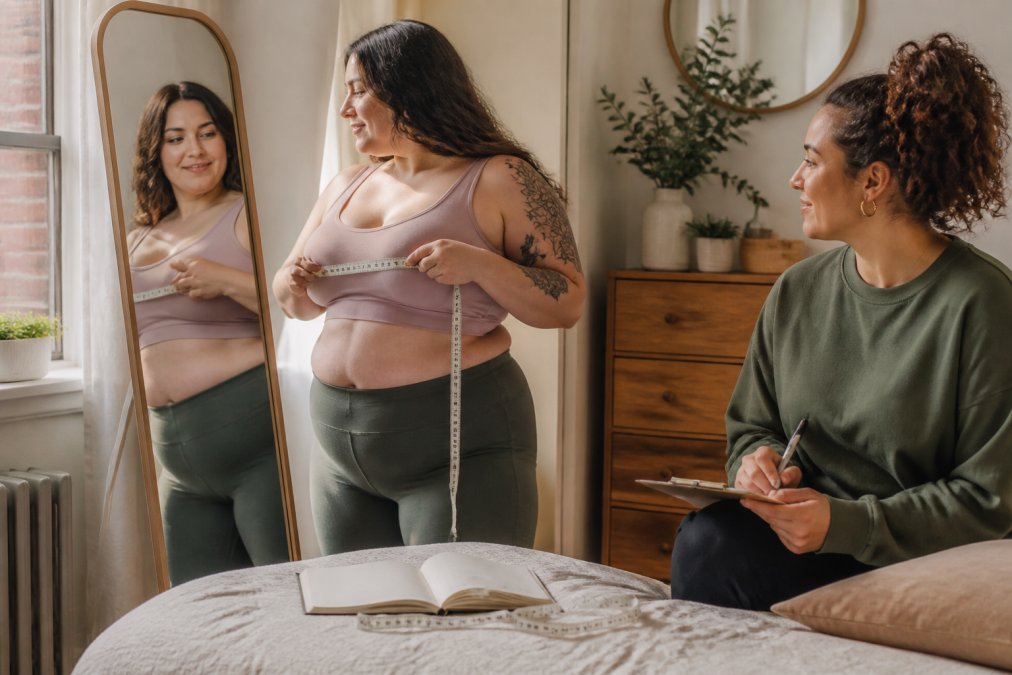
The Five Measurements You Actually Need
- Bust: Around the fullest part of your chest, tape level across your back.
- Waist: At your natural waist, the narrowest point above your belly button.
- Hips: Around the fullest part of your seat, usually about 8 inches below the waist.
- Hollow to hem: From the notch at the base of your neck to where you want the hem.
- Shoulder to shoulder: Across your upper back, from one shoulder point to the other.
Write each number down twice to catch mistakes. Small errors here cause big fit problems later.
Virtual Try-On and Remote Measurement Tools
Not every bride can visit a salon in person. Virtual try-on apps overlay gown silhouettes on your photo, and remote guides walk you through the same five steps on video. These tools help with style direction but cannot replace a hands-on fitting, use them to narrow favorites, then confirm measurements with a tailor or consultant before ordering.
Questions to Ask Bridal Salons About Sizing Before You Book
The best way to avoid a frustrating appointment is to call ahead and ask about sizing. A good boutique answers plainly; a vague answer is your signal to look elsewhere. The key is knowing what a strong answer sounds like versus a deflection.
The Core Questions and What Good Answers Sound Like
- "What is your sample gown size range?" A strong answer names a specific range, like "size 2 to 32" or "size 0 to 28." A weak answer is "we have something for everyone" or "it depends on the designer." Push for the actual numbers.
- "Do you carry sample gowns in size 24 and above?" Good: "Yes, we stock samples in 24, 26, and 28 in our most popular silhouettes." Weak: "We can order anything." Ordering is not the same as trying on.
- "Can you order a gown in my exact custom measurements?" Good: "Yes, and here is the designer's measurement form." Weak: "We'll figure it out at the appointment."
- "How long do made-to-order dresses take to arrive?" Good: a specific window, such as 16 to 24 weeks, plus a rush option. Weak: "It varies."
- "What do alterations typically cost, and who does them?" Good: an in-house tailor or a named partner, with a typical range. Weak: "We can recommend someone."
- "Can I bring a support person, and is there a limit?" Good: a clear number and a comfortable seating setup. Weak: "Space is tight."
- "Do you have real customer photos in my size range?" Good: an album, a tagged social feed, or a lookbook. Weak: "We don't photograph clients."
How to Verify a Salon's Claims Before You Drive Over
A phone answer is a starting point, not proof. Before you book, do three quick checks:
- Cross-check the designer's published size chart. Most designers post measurement charts on their own sites. If a salon says it can order your size but the designer's chart stops short, that is a red flag.
- Look for tagged customer photos. Search the salon's social tags and reviews for real brides in your size range. A salon that only shows size 2 models in its feed may not actually stock your range.
- Ask for the sample size list in writing. A quick email request, "Can you send the sample sizes you carry by silhouette?", separates salons that know their inventory from those that guess.
Your Salon Vetting Checklist
Use this checklist when you call or email a salon. One that checks most boxes is worth a visit; one that checks few is worth skipping.
- Confirms sample sizes in your range, with specific numbers
- Offers made-to-order or custom measurements
- Shares a written measurement chart from the designer
- Explains the alteration timeline and cost range
- Welcomes a support person of your choice
- Has real customer photos in your size range
- Names the specific designers whose ranges cover your size
- Discloses any rush fees or trunk-show pricing upfront
What to Do If a Salon Fails the Vetting
If a salon dodges your questions or admits it does not stock your range, ask whether they can borrow a loaner gown in your size from a sister store or the designer, many boutiques do this for a serious buyer. If not, move on; enough salons stock a real range that you need not settle for one that treats your size as an exception.
Last Rodeo Bachelorette & Bachelor →
Sample Gowns, Made-to-Order, and Custom Measurements Explained
Sample gowns are the floor models you try on, usually a single size per style. Made-to-order means the designer cuts your gown to the size you select from their chart. Custom measurements go further: the gown is built to your exact numbers.
| Option | What It Means | Best For | Typical Timeline |
|---|---|---|---|
| Sample gown | Floor model in one size | Trying silhouettes | Same day |
| Made-to-order | Cut to a standard size | Most brides | Several months |
| Custom measurements | Built to your numbers | Hard-to-fit bodies | Longer lead time |
| Off-the-rack | Buy and alter | Tight timelines | Immediate |
What Sample Sizes Are Actually Available
Sample size ranges vary widely: some salons carry size 2 to 30, others stop at 12. Call ahead for the exact range before you book. If a salon lacks your size, ask whether they can clip a larger sample or order a loaner gown, many boutiques will work with you.
Budget-Conscious Inclusive Shopping and Emotional Boundary Setting
Inclusive shopping does not have to mean a bigger bill or enduring comments about your body. Most guides cover one or the other; this section covers both, because the two problems tend to show up in the same appointment.
Budget-Conscious Inclusive Shopping: Where the Real Savings Are
Made-to-order and custom gowns often cost more than off-the-rack, so plan your budget before you fall in love with a gown. The trick is knowing which levers move the price.
- Sample sales. At the end of a season, salons sell floor models at a discount. The catch: sample sizes are limited, so call ahead and ask which sizes are on the rack. A sample sale is only a deal if the sample fits your range.
- Trunk shows. Designers bring a wider size range to trunk shows than a salon normally stocks, and many offer limited-time pricing. Ask the salon which trunk shows are coming up and whether the visiting designer cuts your size.
- Off-the-rack plus alterations. Buying a gown in your street size and having it tailored can cost less than a custom order, especially if the silhouette is forgiving. The trade-off is a shorter lead time and less control over fabric and detailing.
- Bridesmaid and reception dresses. A formal gown in a color you love can work as a reception dress at a fraction of a bridal gown price, and many brands now cut these in extended sizes.
- Resale and consignment. Gently worn gowns in extended sizes do exist, but inventory is unpredictable. Set alerts and check often rather than expecting to find your size on the first visit.
- Alteration budget. Set aside a realistic alteration fund from the start. Hemming, taking in the bodice, and adjusting straps are common; a corset back conversion is a bigger job. Ask the salon for a typical range before you commit.
Emotional Boundary Setting: Scripts You Can Actually Use
Bridal shopping can be emotionally taxing, especially when a consultant or well-meaning relative comments on your body. You are allowed to set boundaries without justifying them. A few scripts that work:
- To a consultant: "I'd like to focus on how the gown fits, not on the size number. Can we talk about the silhouette instead?"
- To a relative who comments on your weight: "I'm not discussing my body today. I'd love your opinion on the neckline, though."
- To a crowd that is overwhelming you: "I need a few minutes alone with the mirror. I'll come get you when I'm ready."
- To a consultant pushing a style you dislike: "That's not the direction I want. Let's move on to the next option."
- To yourself, before the appointment: "The number on the tag is a pattern size, not a verdict. I am here to find a gown, not a grade."
Choosing Your Crew on Purpose
Who you bring matters as much as where you go. One or two supportive people usually beats a crowd, which multiplies opinions and dilutes your own. If someone tends to comment on your body, invite them to the reception instead of the appointment, and ask the salon about private appointments that remove the audience entirely.
Frequently Asked Questions
What is a bridal size 10 equivalent to in street sizing?
Bridal sizing typically follows older pattern standards that run about two sizes smaller than what you buy at a department store. Always check the specific designer's size chart rather than assuming your usual number. If you're between sizes, ordering based on your largest measurement is often recommended, since taking a gown in is generally easier than letting it out.
How can I tell if a bridal boutique is truly size-inclusive?
When looking for inclusive sizing, it's helpful to ask what sample sizes are stocked and whether gowns are available in a wide range of sizes. A truly inclusive retailer will often have samples across a real size range. Inquire if made-to-order options are available and if there are any extra charges for extended sizes. Requesting to see a size chart before an appointment can also be beneficial.
How do I accurately measure myself for a bridal gown?
When measuring for apparel, wear a well-fitting bra and thin clothing, then use a soft measuring tape. Measure your bust at the fullest point, your natural waist at the smallest point, and your hips at the widest point. Keep the tape snug but not tight, and having someone help you can improve accuracy. Compare your numbers to the specific brand's size chart. When in doubt, sizing up and planning for adjustments is often a good approach.
What should I ask a bridal salon before booking an appointment?
When inquiring about apparel, it's helpful to ask about available sizes and if there are any extra charges for extended sizes. Confirming policies like returns and exchanges is always a good idea. Understanding if alterations are offered and their typical cost can also be beneficial. A retailer that answers these questions clearly is often a good choice.